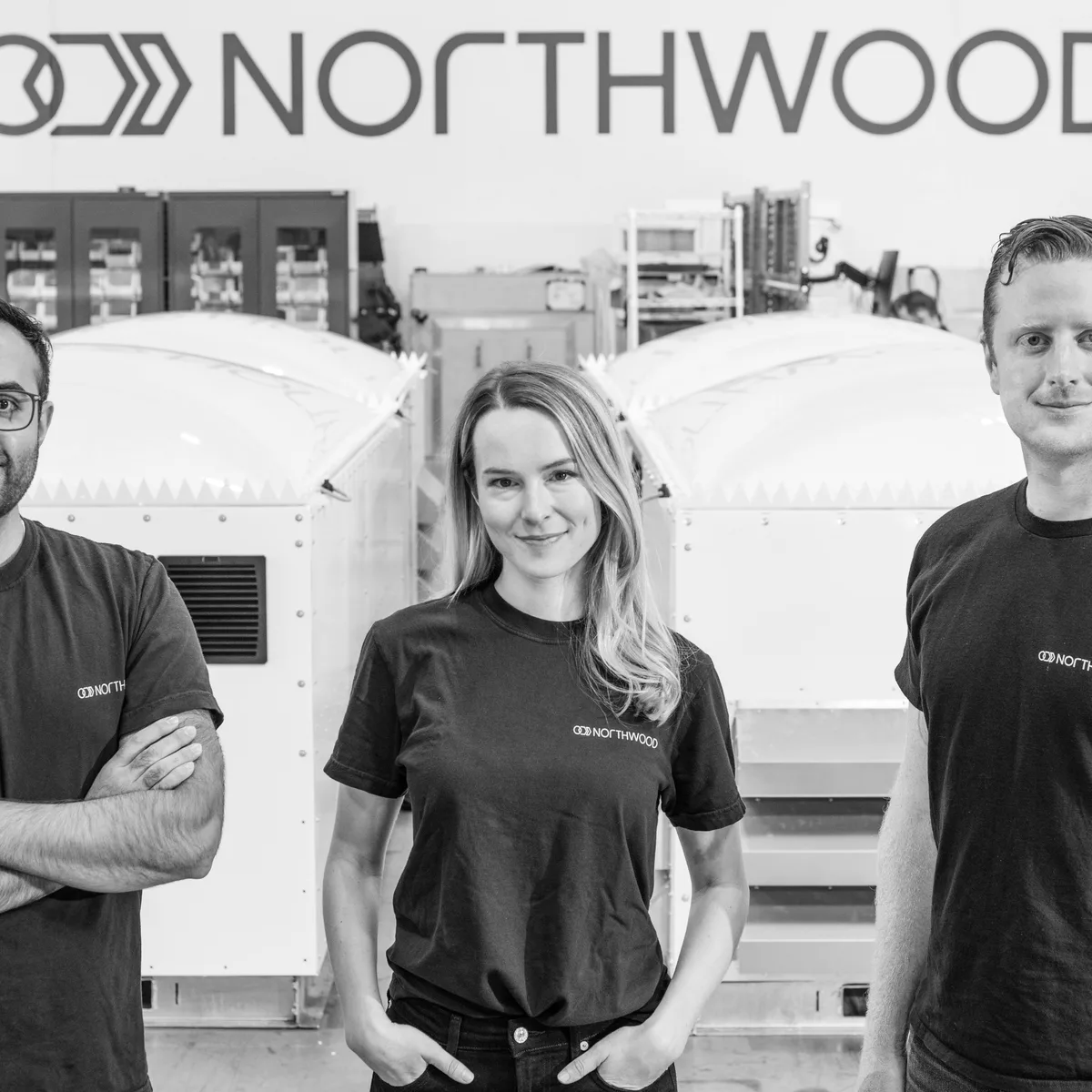
The former Disney actress turned aerospace founder has built a company tackling one of the space industry's most overlooked constraints: getting data between satellites and the ground.
Bridgit Mendler's space infrastructure startup Northwood has raised $375 million in Series C funding at a $2 billion valuation, less than nine months after announcing its previous round.
Andreessen Horowitz and DFJ Growth co-led the investment, with participation from Alpine Space Ventures, Washington Harbour Partners, Stepstone Activate and In-Q-Tel, the investment organization associated with the US intelligence community.
The new financing brings Northwood's total capital raised to more than $500 million.
Founded in 2022 by Mendler, her husband Griffin Cleverly and Shaurya Luthra, Northwood is building a global network of ground stations that connect satellites to Earth.
While much of the space industry focuses on rockets and spacecraft, Northwood is addressing what happens after those satellites reach orbit.
Every satellite needs to exchange information with equipment on the ground. That includes operational commands, telemetry, images and other data collected in space.
Historically, operators have relied on networks of large antennas, many of which were designed for a much smaller space industry.
As the number of satellites grows, that infrastructure is becoming a bottleneck.
Northwood wants to replace fragmented ground systems with standardized antennas and software that allow satellite operators to access communications capacity across a shared network.
The company's approach combines hardware manufacturing with network software.
Its Portal antenna uses electronically steered phased-array technology to track satellites without relying entirely on the mechanical movement of a traditional dish.
A phased array coordinates signals across multiple antenna elements, allowing the system to direct radio beams electronically.
That creates opportunities to communicate with several spacecraft and switch connections more quickly.
Northwood has also developed Prism, a 2.4-meter parabolic antenna intended for high-throughput satellite communications.
The two products address different requirements, from routine command and telemetry to transferring large volumes of mission data.
Instead of designing a ground station from scratch for every customer, Northwood manufactures standardized equipment and connects installations through its own software.
The company says its modular designs can be transported in conventional shipping containers and brought online rapidly after arriving at a prepared site.
Its latest funding will support a substantial increase in manufacturing and deployment capacity.
In August, Northwood opened a 185,000-square-foot headquarters and factory in Torrance, California, expanding its manufacturing footprint more than fivefold.
The facility is intended to support production of hundreds of antennas annually.
Mendler's route into aerospace has attracted attention because it began in entertainment.
She appeared in Disney Channel productions including Good Luck Charlie and Wizards of Waverly Place before pursuing higher education, earning a degree from USC, studying at MIT and completing a law degree at Harvard.
Her interest in satellite communications developed during the pandemic, when she and Cleverly experimented with building an antenna capable of receiving data from weather satellites.
That project eventually evolved into Northwood.
Cleverly, an aerospace engineer, now serves as chief technology officer, while Luthra leads software development.
The startup has since moved far beyond experimental antennas.
Earlier this year, Northwood announced a three-year contract worth approximately $49.8 million with the US Space Force to support its Satellite Control Network.
The company is providing ground communications capabilities for government spacecraft, including missions operating in geosynchronous orbit.
That contract gives Northwood a significant customer in a market where communications reliability is particularly important.
Military and intelligence satellites must remain accessible even when individual ground stations are unavailable or communications are disrupted.
A distributed network offers the possibility of routing operations through alternative locations.
Northwood says it has deployed six ground station sites capable of supporting multiple orbital regimes across two continents since its February Series B.
It has also demonstrated geosynchronous command capability through a commercial phased-array system and begun deploying its newer high-throughput antennas.
The company plans to expand the network substantially over the coming years.
Mendler told Payload that Northwood wants to reach hundreds of sites and eventually exceed the scale of existing ground station networks.
The business model extends beyond selling antennas.
Northwood wants satellite operators to purchase access to communications infrastructure as a service, with its software coordinating antenna scheduling, network availability and data routing.
That would make ground connectivity more similar to cloud computing: customers use shared infrastructure rather than building and operating every component themselves.
It is an attractive proposition for smaller satellite companies that cannot justify developing their own global ground networks.
But the market is not empty.
Companies including KSAT, SSC Space and AWS Ground Station already provide satellite communications services, while major satellite operators often maintain substantial infrastructure of their own.
Northwood will need to demonstrate that its standardized hardware can deliver better economics and sufficient reliability to persuade customers to shift important operations onto its network.
The company has also secured a separate multi-year credit facility from HSBC Innovation Banking to support working capital and expansion. The amount was not disclosed and is not part of the $375 million equity round.
Northwood has not published revenue or profitability figures alongside the financing.
Its new valuation reflects investor confidence that ground infrastructure will become increasingly valuable as commercial and government satellite activity grows.
For Mendler, the immediate test is manufacturing and deploying enough reliable equipment to turn a promising hardware business into a global communications network.
The satellites may attract most of the attention, but Northwood is betting that the infrastructure connecting them to Earth could become just as important.
Sources: Northwood announcement · Payload · Technology · Series B and Space Force